
Overview
DLZ was selected to provide services for wetland delineations and design services for a new toll plaza near the Indiana border on the Ohio Turnpike. The location and design of the new plaza impacted sensitive environmental resources, including several wetlands delineated by DLZ during the preliminary alternatives development for the plaza location.
Process
DLZ performed wetland delineations within the areas proposed for disturbance as part of the new toll plaza and associated ramps, parking, and other construction. DLZ also assisted OTIC with review of options for impact avoidance and minimization as part of the permitting process with the U.S. Army Corps of Engineers (USACE) and Ohio EPA.
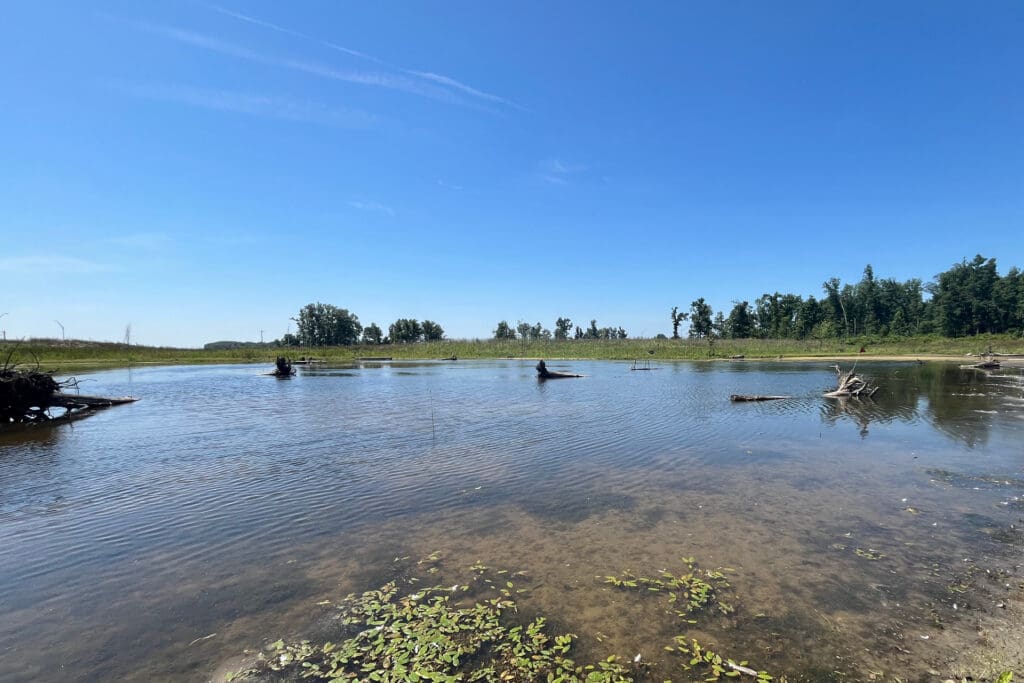
DLZ also assisted OTIC with a review of mitigation options for unavoidable impacts to wetlands. There were no wetland banks within Ohio near the project that could be utilized, which resulted in on-site mitigation being selected. DLZ assisted OTIC with the identification of a suitable mitigation site immediately adjacent to the new plaza and performed the necessary site investigations and wetland mitigation design for a minimum of 5.52 acres of forested wetland, 0.12 acres of emergent wetland, and 3.14 acres of upland. Additional investigations, including a review of several protected species, were required on the mitigation site before disturbance.
As part of the Wetland Mitigation Plan developed for the individual wetland permit from the USACE, OTIC provided a total of 21.47 acres within an Environmental Covenant. This area included the constructed wetland, a portion of the Category 3 wetland that was impacted, and an upland buffer surrounding the wetland that included a large area of mature upland hardwoods. DLZ developed the mitigation design and prepared construction plans, assisted with responding to questions during the bidding, and provided construction assistance, including preparation of the post-construction report required by the USACE and OEPA permitting. The site features a deeper semi-permanent pool and vernal pool area for wildlife to utilize during the spring for reproduction, along with a forested shelf that has a number of logs and root wads placed as summer habitat when the water levels are lower. Two large upland mounds were constructed and provide sand mounds for use by nesting turtles and brush piles for many different wildlife species to use as habitat. The seeding of these mounds was completed with a native pollinator mix to encourage use by a variety of invertebrates and birds.